



Lately, every product blog I read seems to be about one thing: Taste Is All That’s Left. Good Taste is the Only Real Moat Left. Good Taste Can’t Be Taught, Bought, or Learned. Personal Taste is the Moat (plucked at random from my browser history, not putting any of these folks on blast).
Orange Website, the Lennysphere, everywhere you look is positively awash with pieces about taste, conviction, craft, judgment, and any other lofty, vaguely pontifical language.
Present-day memification notwithstanding, this has been brewing for a long time. It started before the AI wars and even before the “craft” obsession spurred by the likes of Linear and Notion. Paul Graham’s Founder Mode was a viral battle cry of the same ilk, but it wasn’t the flashpoint. It goes back to at least the hyper-quantification of SaaS. But as tech is wont to do, we have reinvented from first principles a much older debate: the nature, origin, and effectiveness of intuition, and the “dueling” schools of thought: Naturalistic Decision Making (NDM) and Heuristics and Biases (HB).
The risk in our recent fixation is that well-meaning product teams yield too much to vague intuitions—to the exclusion of formal methods—replacing our product roadmaps with “trust me bro” or, more precisely, “trust me until I land that juicy MTS job at Anthropic, then the fallout is your problem.”
By unmasking “taste” for what it really is, we will show whose intuition deserves trust, how to improve that judgment over time, when to apply it during product development, and why a tight feedback loop combining research, data, and rigorous product management still matters.
Rebellion of the Masses
The ongoing enshittification of nearly every product you love can be attributed to metrics and performance management. From the so-called pirate metrics1 to basic click-through rates, everyone knows their job performance will be judged harshly if these don’t move in the right direction.
It starts innocently: we need more revenue, and customers who use the product more (activation) tend to renew (retention) and tell their friends (referral). Duh. But we act as if we’ve just discovered fire and reorganize the entire business around it: tracking feature engagement, running experiments, and shipping whatever lifts usage. A few months later, it mostly works, revenue is up, and now quantitative product management rules the land.
Next quarter, every team submits metric-based OKRs like “Increase total monthly minutes of video watched by 12%” or “Increase the number of share button clicks by 3%.” Make sure they know they’ll be graded against these OKRs. Add in a few layers of management so the person accountable for the OKR is 5 hops removed from the actual work. Now the trifecta is complete. Your teams will run around Making Number Go Up™ with dark patterns and dogwater incrementalism—there’s no room for big bets when you have only one quarter to hit your numbers.2 This leads directly to the “blue bubble” era—those insipid popups that scream “hey! Hey you!!1 Have you seen this BUTTON? I need you to click it, or I get fired.”


I’ve lived through this collective myopia enough times to determine it’s endemic to every hierarchical structure within 5 square miles of a dashboard.
Back in my Google Drive days, we wanted to put AI-generated summaries inside file hovercards. You may be surprised to learn that hovercards, an out-of-the-way feature, were crazy popular. Summaries would help users dig through large folders and search results without opening 20 random documents. We already had the infra and UX prerequisites in place; this whole feature would take at most 1 week to ship.

Guess what? It didn’t happen (gasp). See, we had an annual OKR to grow “Drive consumption,” measured by how often users open files. Summaries meant fewer file opens, which would push the metric in the wrong direction and send our directors into conniptions. When I raised the idea of changing the measurement to include hovercard views (or, idk, abandoning a 12-month-old OKR for something more relevant), it turned into a game of corporate chutes and ladders. First, no one could figure out who was even allowed to change the metric’s definition; then no one wanted to spend the political capital; then I finally gave up.
Every time you have wondered aloud, “why won’t <Product X> just do <Y>? It would make my life so much better,” you can guess a pretty credible theory by just pondering the metrics that organization is optimizing.
Now here’s the deal: no one likes this, and no one actually believes this is the correct way to develop a product. Not the developers, not the PMs, not the executives who set the targets in the first place. You and your teammates are simply additional victims of Management By Objective: having a job you love—human-centered, creative problem-solving—reduced to P-hacking so your boss can get promoted.3 Hey, at least they’ll invite you over for a pool party at their megamansion once the bonus check clears 🤷♂️
But worry not, dear citizen. The product teams of the world are in full, open rebellion. Taste, craft, judgment, and conviction let us reject MBO tyranny, restore autonomy, and put humans back at the center of product craft!
At least, I sure hope so. Unfortunately, like most superheroes wearing capes, the dogma of taste has its own problems.
Iatrogenic Effects
The argument goes: building things is so cheap now that taste is the only moat—teams that make judgment calls an LLM cannot replicate are destined to outcompete. This sounds credible on its face, except the cure might be worse than the disease.
First, I’m not so sure that an LLM will struggle to replicate this. If product taste stems from a blend of experience and cultural immersion, well, bad news: LLMs are, by definition, trained to reproduce the ineffable statistical average of all documented human experience.
More problems emerge as second-order consequences:
I just wanna be that guy: it’s not clear how one develops good taste. As very senior practitioners start shooting from the hip, juniors will imitate this practice, believing it’s how the job is done. But without experience and accumulated wisdom, they are liable to vibe-PM their way into unemployment, or worse, destroy entire companies.
Head in the sand: taste has become a socially acceptable argument for ignoring unambiguous empirical evidence. A feature launching to near-zero engagement is justified as needing another round of refinement to meet “table stakes” (cursed phrase), or just “naturally slow” adoption curves. Either way, the outcome is throwing yet more good money after the bad.
No fighting in the war room: there is no sane or productive way to debate matters of taste. The debate will skip straight to outright caviling, anodyne truisms, and cherry-picked anecdotes. No one will seek truth, and the squabbling will end only when someone with a big title says “OK, enough” and makes a call.
Together, this is a recipe for spawning the next generation of product oligarchs who suppress cross-functional collaboration and any sense of agency, autonomy, or purpose. The old fig leaf for this behavior was “PMs are the CEO of the product.” Now it’s gonna be “PMs are the tastemakers.”

Taste is just Tacit Knowledge
What the kiddos now call “taste” is mostly a well-researched phenomenon in cognitive science: tacit knowledge. By understanding the mechanics and limits of tacit knowledge, you can both accelerate your acquisition of “taste” and determine when to use it for maximum effect.
“Tacit Knowledge” is knowledge that is internalized, embodied, and uncodifiable. Michael Polanyi articulated this best: “We know more than we can tell.” This concept is most evident in physical processes like balancing while riding a bike or recognizing someone’s face. We perform these acts automatically, without mentally attending to any one particular detail or sub-process. You don’t recognize your friend by the shape of their nose or the specific tint of their iris; instead, you instantly and automatically declare, “that’s Cody,” without being able to articulate exactly how you arrived at that conclusion.
This also occurs in more declarative/fact-based domains: the earliest studies that motivated this concept examined master chess players, neonatal nurses, and fire commanders in what Gary Klein calls Recognition-Primed Decisions (RPD). When a fire commander makes the snap judgment to pull back before a building collapses, they process thousands of discrete perceptual signals and match patterns against a repertoire of experience, training, and technical knowledge. The conscious mind often cannot reconstruct the exact reasoning, qualia, and experiences that informed that judgment. “The situation has provided a cue: This cue has given the expert access to information stored in memory, and the information provides the answer. Intuition is nothing more and nothing less than recognition” (Simon, 1992).
This explains why staff engineers and seasoned founders feel suffocated by 5-pagers, 64-row RICE matrices, and endless architecture/product/design reviews. Their brains already ran RPD in 400ms, and now they get to spend the next 8 weeks trying to explain themselves when they don’t even really know why themselves!
None of this implies that the “tacit knowledge” in question cannot be encoded in language somehow. Rather, that the information resists both introspection and articulation. In fact, when pressed to explain their actions, humans tend to confabulate. In Johansson et al.’s manipulated choice experiment, participants were shown two faces and asked to pick the most attractive, then, through sleight of hand, were handed the photo they had rejected and asked to explain their choice. Most didn’t notice the swap and gave confident, detailed explanations, suggesting that a stated rationale doesn’t necessarily reflect the reasoning used.
The limits of tacit knowledge abound. Not all intuitions are created equal, and some can be extremely wrong. Because tacit knowledge isn’t easily articulated, it’s not obvious how we judge who has it. To distinguish between knowledge and delusion, we must rely on observed performance and whether the individual’s track record beats random chance on the same task. But under such conditions, skill, luck, and a favorable environment all look the same (“everyone’s a genius in a bull market”).
This same problem complicates the acquisition of tacit knowledge. When feedback is greatly delayed, weak, or inconsistent, our minds draw spurious conclusions and invent cause→effect connections where none exist. Robin Hogarth described the conditions that help/hinder the formation of tacit knowledge—
Kind Learning Environments: rules are clear, feedback is immediate, unambiguous, and accurate (e.g., golf, chess, playing an instrument). Here, repeated exposure and practice reliably produce genuine intuition.4
Wicked Learning Environments: information is incomplete, the rules change, feedback is delayed, noisy, or entirely misleading. Worse, wicked environments can reward bad decisions, which teaches practitioners the wrong tacit lessons.
While parts of our craft are kind (e.g., optimizing database performance), the really big strategic product management stuff we’ve been talking about is decidedly wicked:
Incomplete information: duh. You don’t know what your competitors are planning, what market shocks are coming, or what Joe Schmoe is really thinking when choosing between Power BI and Tableau (or Cool Ranch and Nacho Cheese, or…).
Rules change: a law passes that obsoletes your whole business overnight, or a tech breakthrough completely shifts consumer preferences. Everything you learned 2-3 years ago could be worthless.
Feedback is delayed: long B2B sales cycles, extended onboarding, and internal change management mean the all-important conversion/adoption signal doesn’t arrive until 6-18 months after you build the thing.
Feedback is noisy: canceled subscriptions could be real churn or just users who hate auto-renew. Your exit survey doesn’t even include this option, so the signal gets lost in a sea of “Reason: Other” (seriously, WHY do you people do this!?)
Feedback is misleading: you ship an atrocious redesign, but marketing coincidentally dumps a seven-figure ad blitz the same day, so signups spike 20%. The redesign is heralded as the Second Coming.
As a result, many of us think we “know better” but are really just vibing. In my experience, the most superstitious people you will ever meet are very senior product people (Eng or PM)—dismissing ideas for incomprehensible reasons, or repeating successful strategies from their past like some PM rain dance. They have learned to spot inconsistent cues and link them to spurious outcomes, and as a result, their product sense has become dangerously miscalibrated.
This is unsurprising, given Tetlock’s study of expert political and economic forecasters. He tracked 27,451 expert forecasts and found they rarely beat laypeople…or even random chance. When you really think about what we’re doing when designing companies/products, it’s not far off a long-term economic forecast 👀
Yet there is hope: crazy outliers known as superforecasters (also studied by Tetlock, go figure) beat the crowd’s aggregated wisdom by more than 50%. You can find these folks on the leaderboards of prediction markets and forecasting competitions like Metaculus, where they share detailed reasoning and analysis behind their conclusions. What you’ll notice is that these aren’t mystics, but practitioners who excel at improving their performance in wicked environments through disciplined methods and calibration:
Anchoring to base rates.
Breaking hypotheses into granular components.
Updating their beliefs frequently, in small increments, as new data arrives.
Using Bayesian, probabilistic reasoning rather than black-and-white thinking.
Measuring their performance objectively with Brier scores.
Undergirding it all is the modern information ecosystem, which provides access to hard data and crowd wisdom at scales and speeds that were unthinkable. Agentic AI has only accelerated this. Top human superforecasting groups like Samotsvety build sophisticated tools, simulations, and data pipelines to aid in their craft.
The lesson here is that the feedback loop is everything. You don’t need to wait for the singularity; we already have the techniques to overhaul the information environment we find ourselves in and make product development less wicked.
Using Tacit Knowledge in Your Product Pipeline
Since taste is mostly tacit knowledge of user psychology, system affordances, and market dynamics, it fits comfortably in a healthy, balanced breakfast product lifecycle:
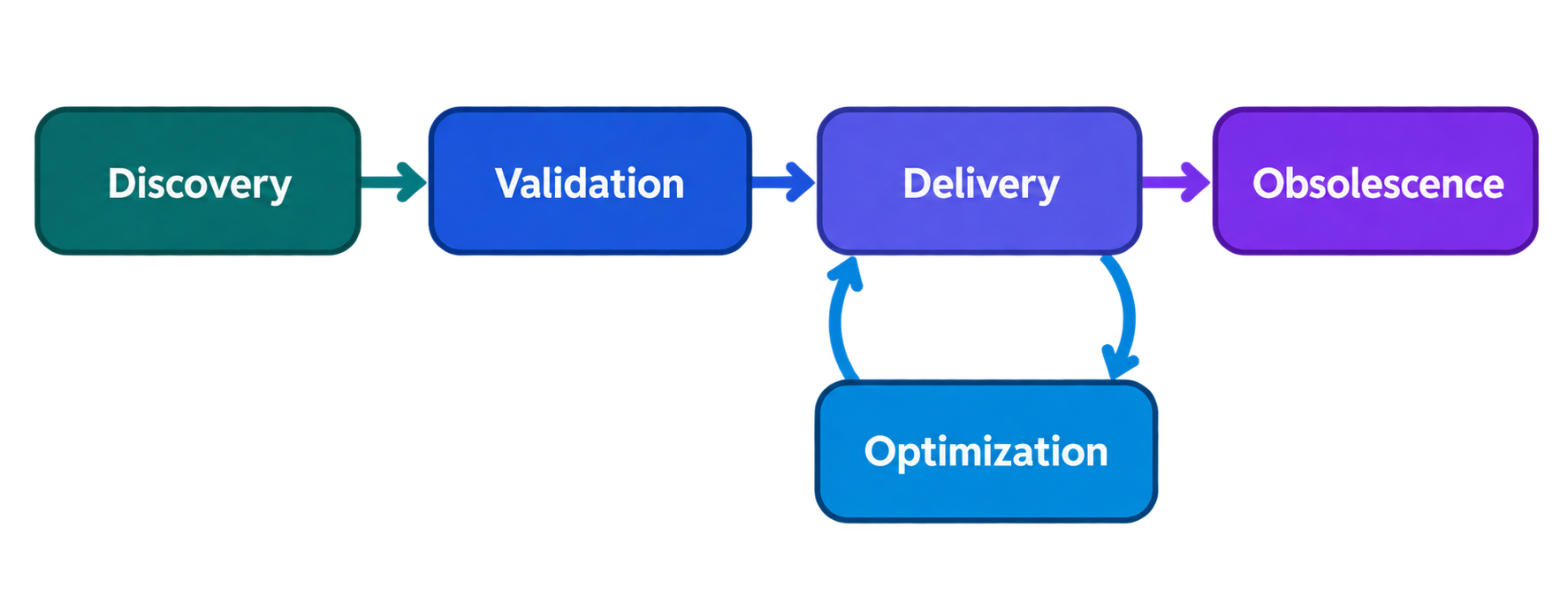
Whether you follow a strict process or not, all ideas flow through these 5 stages. Moving through a stage requires judgments like “is this a good idea?” (validation), “how should this work?” (delivery), or “did users like it?” (optimization/obsolescence).
To answer these questions, mature product organizations use a rich toolbox of formal methods spanning data science, UX research, engineering, and product management.
Each method has a different time and monetary cost. You wouldn’t spend weeks and tens of thousands of dollars running extensive user interviews to decide whether your word processor needs a “print” button. On the other hand, large investments may warrant a more thorough investigation before you proceed to implementation. Each method also has different levels of predictive validity. A production MVP with real user analytics is the highest-fidelity test, but it also costs the most!
The methods you use will depend on the relative cost of being wrong, and that depends on more than just “how many SWE-hours does it take to build?” For example, enterprise software cannot radically change every few days, and some customers may even have a contractual requirement for advance notice (time to vet the new feature and prepare their employees/information security policies/whatever). If you delete a feature because an A/B test failed, you may find yourself with an even bigger problem!
At some point, you still have to make a judgment with imperfect information. The trick is to make sure that each decision leaves you better equipped to make the next one—you need to shift “taste” from an individual attribute to an organizational capability:
Record all consequential decisions: Each decision should include any assumptions it is based on, what you expect to happen, how confident you are (a percentage), the actions required to actuate the decision, and when/how you’ll check if the decision actually worked the way you expected (e.g., MAU should increase at least 50 bps QoQ by end of November). This is exactly the advice Drucker offered in The Effective Executive… now actually do it rather than nod along 🙃 All my projects keep a dedicated Decision Log (“DLOG”) for this purpose.
Get blameful: I know this won’t be popular, but you should also record who, specifically, drove a given decision. Blamelessness is not the same as treating everyone’s judgment as equally reliable. The point is calibration, not evaluation; this should never come back to bite someone in a performance evaluation.
Quarterly DLOG reviews: Look over closed decisions and compare outcomes against predicted confidence, broken down by person and domain. This is your equivalent of a Brier score for forecasting. It’s the only way to know “have I got good taste truly?” You may have a penchant for feature prioritization but a horrible marketing track record. Either way, this record-keeping closes the feedback loop for decision-makers.
Postmortem the gaps: Whenever you rely heavily on intuition, run a postmortem. Did you lack customer research, product instrumentation, a cheap way to prototype, or a meaningful measure of success? Some uncertainty is unavoidable, but when an organization has to make an important decision in the dark, treat that as an opportunity to improve its observability.
If being wrong is cheap and reversible, or you can’t test the idea without shipping it, go on judgment, add instrumentation, and log the bet. If being wrong is expensive or sticky, spend your effort shortening the feedback loop instead.
With this process, over time you will find that most decisions have at least some data or insight to reduce uncertainty, and individuals become more in tune with the product and improve their hit rate accordingly.
The Real Taste was the Friends We Made Along the Way
Metrics were supposed to make product development more rational, but they became a substitute for rationality. We’ve spent the last decade watching companies systematically optimize away the very things that made their products worth using.
Taste has captured the zeitgeist because it is both a rebellion against the resulting loss of autonomy, and also the first defensible redoubt against having our jobs pillaged by AI…but this risks reproducing the same problem. In both cases, we’ve elevated one particular way of making decisions beyond all reason.
Worse, relying on a handful of god-sent mentats is just deferred maintenance. Eventually, your company needs to build the epistemic machinery necessary to extract truth from the environment, rather than depend on exceptional individuals to do all the thinking. The more durable advantage is an entire organization that continually improves its ability to observe the world, make informed judgments, act on them, and learn from the consequences.
The point isn’t to replace data with judgment. It’s to restore judgment to the people who use the data.
AARRR: Acquisition, Activation, Retention, Referral, Revenue. Get it!? “Arrrr” like a pirate says! Please laugh.
AI coding doesn’t change this or suddenly relieve time-pressure-driven incrementalism. We’re talking about product usage and adoption—trailing indicators that measure not how quickly Claude vomits tech debt into your repo, but rather customer habits. Customer behavior evolves at the frustratingly slow speed of humans even in the year of our lord 2026.
My Product VP friends reading this are probably going, “No! My team isn’t like that! We have a customer-obsessed culture and…” Maybe so! The problem is that no one is gonna tell you otherwise. If culture eats strategy for breakfast, then incentives eat culture for lunch. Wait till you see what happens at supper. Especially in a time when job anxiety and fear are at an all-time high.
Note that both kind and wicked environments can feature high uncertainty. Gambling is, bemusingly, a kind environment because of the clear, immediate feedback. Skill and the ability to identify favorable bets improve performance over time even if each outcome is not successful. What matters is the availability of information which is causally linked to outcomes—this is what Kahneman and Klein refer to as a “high-validity environment.” As this example shows, it’s not always obvious whether a given environment is valid.